What Is an Anti-CRM? The Field Sales Shift, Explained

Omkar Pandharkame
Co-founder of Otto.
Anti-CRM means keep the CRM, stop making reps type it after visits; a short talk becomes the note and field updates It exists because the data is empty, not because RevOps was wrong to buy Salesforce: 91% of CRM data incomplete (Salesforce via Databar, 2025) Plain cause: reps type at night for a screen they never open Field sales first: plant visits have no Zoom recording, and no desk between stops Score vendors on write-back, fewer rituals, IT control, and a pilot on your real fields If you run RevOps or a branch, skip the drama about killing Salesforce. Ask a boring question: after a plant v
An anti-CRM is a loud name for a simple idea: keep your CRM, stop making reps type into it after every visit.
Usually the rep talks for a couple minutes after a customer stop. That talk becomes the meeting note, the field updates, and the follow-ups. Salesforce or HubSpot can still be where everyone reports from. You are fixing empty fields, not ripping out the system.
If you heard the term and wondered if it is real or marketing noise, this is the plain version: where it came from, how it works, who it helps (reps and RevOps), and what it is not.

Why did this idea show up?
Not because Salesforce is useless. Because field reps will not feed it the way the rollout assumed.
About 91% of CRM data is incomplete (Salesforce via Databar, 2025). 79% of opportunity data never gets entered at all (Coffee, 2025). RevOps built the system. Half the visits never show up in it.
Leaders keep pushing. 83% of senior execs say they have to continuously push staff to use the CRM (CRM.org, 2025). Still, 63% of CRM initiatives fail (Merkle via CRM.org, 2025). Training and mandatory fields have not fixed route teams the way people hoped.
Managers say it plain: "My reps won't update Salesforce." That is the real sentence. Not "reps hate software." You are asking for unpaid typing after a full route, for a screen they never open. RevOps still needs clean fields and a forecast. That is fair. Field reps just can't feed those fields like desk teams: no quiet gap between stops, no Zoom recording to lean on, only the laptop at home. They are not lazy. They are tired. Anti-CRM is how you keep the CRM spend and stop fighting the people who have to fill it.
How does it actually work?
Data flips direction. Instead of the rep going to the system, the system meets the rep where they already talk.
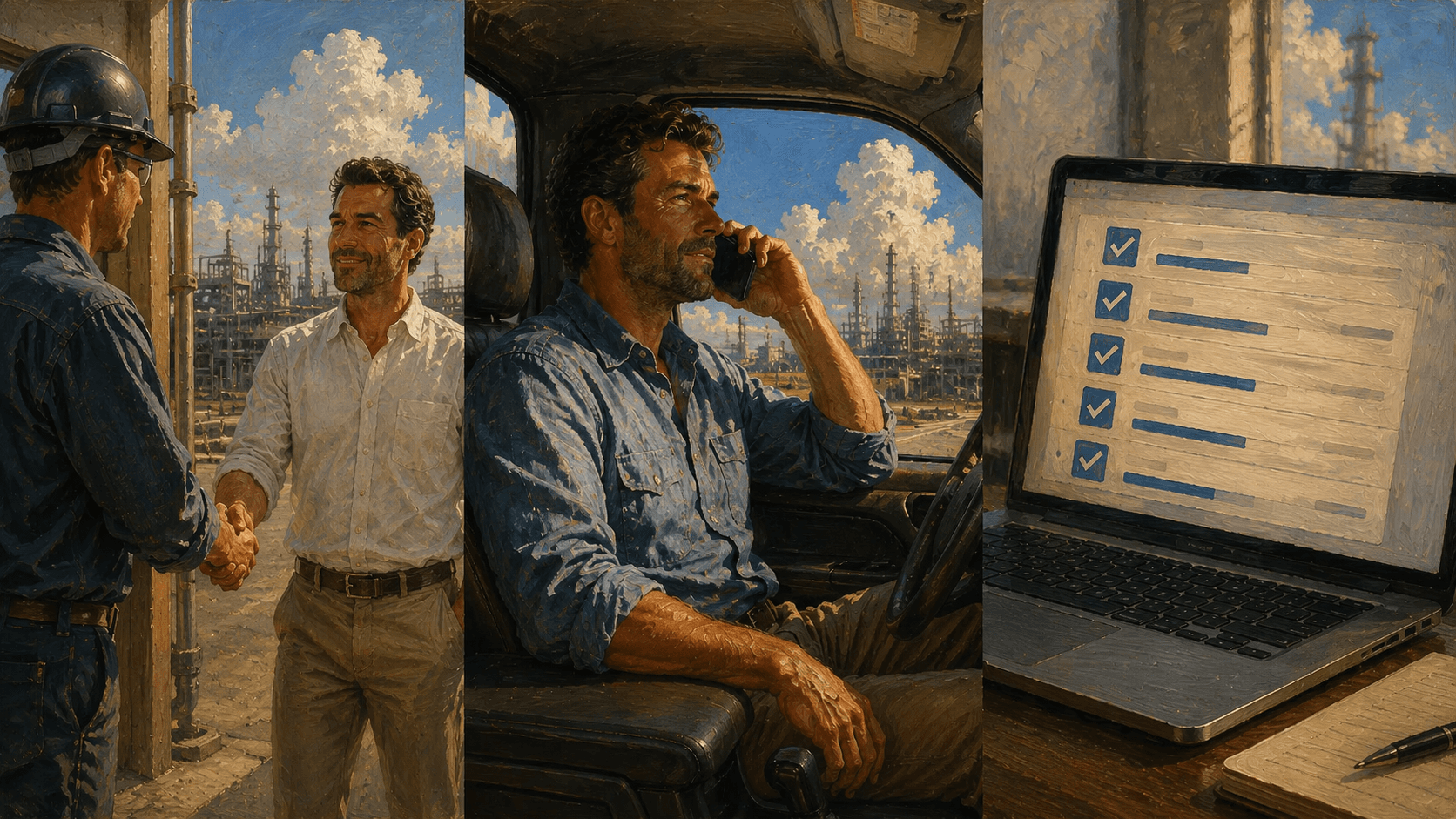
- Visit ends at a plant, counter, or job site.
- Rep talks about two minutes from the truck: who they met, what was quoted, what the customer worried about, what was promised.
- The tool does the typing: meeting logged, fields updated, follow-up drafted, quote flagged, manager informed.
The product type doing this is often called an AI sales coordinator. Plain version: you talk, it writes the CRM work. Some teams also get a morning briefing on accounts and open quotes before the first stop.
The CRM underneath can stay. What leaves is the keyboard time after the route. For the step-by-step, see how to automate field sales CRM updates.
How does this sit next to the CRM you already own?
Think "Salesforce stays, typing goes." Not "throw out the CRM."
- Job - Your CRM today: History, pipeline, reports; Anti-CRM style capture: Get the visit into those fields without night typing
- Who feels it first - Your CRM today: Managers and RevOps; Anti-CRM style capture: Reps in the truck
- When records update - Your CRM today: When someone types; Anti-CRM style capture: Minutes after the visit, from a short talk
- What good looks like - Your CRM today: Forecast you can trust; Anti-CRM style capture: Same CRM, fuller records, fewer chase emails
- When it breaks - Your CRM today: Empty fields, side spreadsheets; Anti-CRM style capture: Skipped debriefs show as missing visits
The fight is with "type it tonight," not with owning a CRM.

Why field sales first?
The last wave of sales tools assumed a desk and a recording. Gong, Chorus, Fireflies got good at Zoom and phone. A plant visit has nothing to record. No transcript to clean up. That whole category never fit the truck day (more on whether AI note-takers work for field visits).
Field days also have almost no typing windows. Across industries only a minority of the week is selling time (full numbers: admin benchmarks). Pressure built where typing was hardest and data loss was worst: industrial and outside routes.
For a product-level comparison of "call coaching" vs "field capture," see this industrial field sales comparison.
What an anti-CRM is NOT
- Not "no CRM." The record still matters. Managers still need visibility. The "anti" is about data entry burden, not about killing record-keeping.
- Not another login on the pile. If it adds work and more typing, it is the old model with new branding. Test: did evening admin go away?
- Not a dumb transcript dump. A wall of text nobody structures is still work for someone. The useful tools write real fields, follow-ups, and manager summaries.
Fair question for any vendor, including us: after a customer visit, who puts the structured note into the CRM your Monday meeting trusts? If the answer is still "the rep, tonight, from memory," you have a typing problem no dashboard training will fix.
How to score a vendor (not a rigged test)
Any product can fail these. That is the point.
- Write-back: Does the talk update fields managers actually use, or dump a transcript nobody reads?
- Truck-ready: Built for the cab, not a desk browser later?
- Less work, not more: Which Friday rituals die (status email, manual visit log)?
- CRM relationship: Feeds Salesforce/HubSpot, or demands a full rip-and-replace? Either can be fine if they say it out loud.
- IT and RevOps control: Permissions, objects, audit trail.
- When people skip: What happens if a rep skips debriefs for a week?
- Pilot on your stuff: Will they map to your fields, not only a demo sandbox?
Is this a real trend or a buzzword?
The word is young. The cost of bad data is not. Gartner puts poor data quality at about $12.9 million a year for the average org (Gartner via Databar, 2025). Failure stats above have been ugly for years. Removing the typing step is more honest than training people forever to type at 9 PM. Voice tools only recently got good enough to make it practical.
Will vendors slap the label on old software? Yes. That is what the checklist is for.
Frequently asked questions
What does anti-CRM mean?
Keep the record. Kill the manual typing. Usually a short voice debrief after each visit fills the CRM. 91% incomplete CRM data is the backdrop (Salesforce via Databar, 2025).
Does it replace Salesforce or HubSpot?
Often no. Many teams keep the CRM and add a talk-to-fields layer on top. What goes away is rep data entry, the step where 79% of opportunity data currently goes missing (Coffee, 2025).
What is an AI sales coordinator?
You talk through a visit for about two minutes. It writes CRM updates, notes, follow-ups, manager summaries. Some also brief you before visits. You don't open the CRM to type.
Why do CRM rollouts fail so often?
About 63% fail (Merkle via CRM.org, 2025). 83% of execs still push usage (CRM.org, 2025). Plain cause: the people asked to type get the least back from it.
TL;DR
- Anti-CRM means keep the CRM, stop making reps type it after visits; a short talk becomes the note and field updates
- It exists because the data is empty, not because RevOps was wrong to buy Salesforce: 91% of CRM data incomplete (Salesforce via Databar, 2025)
- Plain cause: reps type at night for a screen they never open
- Field sales first: plant visits have no Zoom recording, and no desk between stops
- Score vendors on write-back, fewer rituals, IT control, and a pilot on your real fields
If you run RevOps or a branch, skip the drama about killing Salesforce. Ask a boring question: after a plant visit, who puts it in the CRM? If the answer is still the rep at 9 PM, you have a field sales admin / second-shift problem. Tools in the AI sales coordinator bucket try to fix that. Otto Sales (Otto) is one product in that pattern for industrial field sales. Use the checklist above on anyone you evaluate.
By Omkar Pandharkame, Co-founder of Otto.